Understanding spatial measurement is crucial in geometry! This section introduces calculating the space within three-dimensional shapes.
Numerous worksheets‚ often in PDF format‚ provide practice‚
and readily available answer keys help verify solutions.
What is Volume?
Volume represents the three-dimensional space a shape occupies. Unlike area‚ which measures surface‚ volume quantifies the capacity of an object – how much it can hold. It’s fundamentally about measuring the amount of space inside a solid figure. Think of filling a box or a cylinder with water; the amount of water needed is its volume.
This concept is vital when working with prisms and cylinders. Calculating volume isn’t just about formulas; it’s about understanding how many cubic units are needed to completely fill the shape. Many educational resources‚ including volume worksheets in PDF format‚ focus on building this intuitive understanding.
These worksheets often present problems involving various dimensions‚ requiring students to apply formulas and practice their skills. Crucially‚ most come with answer keys‚ allowing for self-assessment and immediate feedback. Mastering volume is a cornerstone of solid geometry and has practical applications in numerous fields.
Units of Volume (Cubic Units)
Volume is always measured in cubic units. This is because we’re dealing with three dimensions – length‚ width‚ and height. Common units include cubic meters (m³)‚ cubic centimeters (cm³)‚ cubic feet (ft³)‚ and cubic inches (in³). The “cubed” designation signifies that we’re multiplying three linear dimensions together.
When solving volume problems involving prisms and cylinders‚ ensuring consistent units is paramount. If dimensions are given in different units‚ conversion is necessary before applying the volume formula. Worksheets frequently test this skill‚ presenting problems with mixed units.
Fortunately‚ many volume worksheets available as PDF downloads include answer keys that demonstrate the correct unit conversions and calculations. These resources often emphasize the importance of clearly labeling answers with the appropriate cubic unit. Understanding cubic units is fundamental to accurately interpreting and communicating volume measurements.

Volume of Prisms
Prisms possess uniform cross-sections. Calculating their volume involves determining the base area and multiplying it by the height. Worksheets and answer keys aid practice!
Understanding Prism Bases
Prism bases are the defining polygons that dictate the shape and‚ crucially‚ the area used in volume calculations. These bases can take many forms – triangles‚ squares‚ rectangles‚ pentagons‚ or any polygon‚ really! Identifying the correct base is the first step towards accurately determining a prism’s volume.
Remember‚ a prism is named by its base. A triangular prism has a triangle as its base‚ a rectangular prism has a rectangle‚ and so on. When working with volume worksheets (often found as PDF downloads)‚ carefully examine the diagrams to pinpoint the base shape.
Calculating the area of this base is essential. For example‚ a rectangular base requires length times width‚ while a triangular base needs one-half base times height. Many worksheets provide the dimensions needed for these calculations‚ and checking your work against the provided answer key is always a good practice. Understanding the base is fundamental to mastering prism volume!

Formula for Volume of a Prism (V = Bh)
The volume of a prism is determined by a straightforward‚ yet powerful‚ formula: V = Bh. Here‚ ‘V’ represents volume‚ ‘B’ signifies the area of the prism’s base‚ and ‘h’ denotes the height of the prism – the perpendicular distance between the two bases. This formula highlights that volume is directly proportional to both the base area and the height.
When tackling volume worksheets (often available as PDF files)‚ remember to first calculate ‘B’. This might involve using formulas for triangles‚ squares‚ or other polygons. Then‚ simply multiply that base area by the prism’s height.
Consistent application of this formula‚ coupled with careful attention to units‚ will yield accurate results. Always double-check your calculations‚ and utilize the answer key provided with the worksheet to confirm your understanding. Mastering V=Bh is key to success!
Calculating Volume: Rectangular Prisms
Rectangular prisms‚ also known as cuboids‚ are fundamental in volume calculations. Their bases are rectangles‚ making the process particularly straightforward. To find the volume‚ first determine the area of the rectangular base (B) by multiplying length (l) and width (w): B = l x w.
Then‚ apply the prism volume formula: V = Bh‚ substituting ‘B’ with the calculated base area and ‘h’ with the prism’s height. Therefore‚ V = l x w x h. Many volume worksheets‚ often in PDF format‚ focus specifically on rectangular prisms.
When using these resources‚ ensure all dimensions are in the same units before calculating. The answer key will confirm if your final volume is expressed in the correct cubic units (e.g.‚ cm³‚ m³). Practice with varied dimensions to solidify your understanding!
Calculating Volume: Triangular Prisms
Triangular prisms present a slight variation in volume calculation due to their triangular base. The initial step involves determining the area of this triangular base (B). Recall that the area of a triangle is calculated as B = ½ x base x height (where ‘base’ and ‘height’ refer to the triangle’s dimensions).
Once the base area is known‚ apply the general prism volume formula: V = Bh. Substitute the calculated triangular base area (B) and the prism’s height (h) into the formula. Therefore‚ V = ½ x base x height x prism height.
Worksheets dedicated to triangular prisms‚ often available as PDF downloads‚ provide ample practice. Always double-check your work against the provided answer key‚ paying close attention to correctly identifying the triangle’s base and height. Consistent practice builds confidence!
Practice Problems: Prisms with Various Bases
Mastering prism volume requires applying the V = Bh formula to diverse base shapes. Worksheets frequently present prisms with rectangular‚ triangular‚ trapezoidal‚ and even more complex polygonal bases. The key is accurately calculating the area (B) of each specific base.
For example‚ a trapezoidal base requires using the trapezoid area formula (B = ½ x (base1 + base2) x height). Remember to consistently use the correct units – cubic units for volume. Many online resources offer PDF practice sets with varying difficulty levels.
Utilize the provided answer keys to verify your calculations. Analyzing errors is crucial; identify if mistakes stem from the base area calculation or the final volume computation. Consistent practice with these problems solidifies understanding and builds problem-solving skills. Don’t hesitate to revisit the formulas!
Volume of Cylinders

Cylinders‚ like prisms‚ have volume calculated using base area and height. Worksheets (often PDFs) provide practice‚ and answer keys confirm correct application of the πr²h formula.
Understanding Cylinder Radius and Height
Cylinders‚ fundamental 3D shapes‚ require understanding two key dimensions: the radius (r) and the height (h). The radius is the distance from the center of the circular base to any point on the circumference. Accurately identifying the radius is vital for volume calculations‚ as it’s squared in the formula (πr²h).
The height (h) represents the perpendicular distance between the two circular bases. It’s crucial to distinguish height from slant height‚ especially when dealing with oblique cylinders. Many volume worksheets‚ available as PDFs‚ present cylinders with varying dimensions‚ testing your ability to correctly identify both ‘r’ and ‘h’.
Practice problems often include diagrams where students must extract these measurements. Answer keys accompanying these worksheets demonstrate the correct identification of radius and height‚ alongside the complete volume calculation. Mastering these dimensions is the first step towards confidently solving cylinder volume problems.
Formula for Volume of a Cylinder (V = πr²h)
The volume of a cylinder is determined by the formula V = πr²h‚ where ‘V’ represents volume‚ ‘π’ (pi) is approximately 3.14159‚ ‘r’ is the radius of the circular base‚ and ‘h’ is the height of the cylinder. This formula essentially calculates the area of the base (πr²) and then multiplies it by the height to find the total three-dimensional space occupied.
Worksheets focusing on cylinder volume consistently utilize this formula. Many PDF resources provide step-by-step examples demonstrating its application. Answer keys included with these worksheets showcase the correct substitution of values and the resulting volume calculation.
Understanding the order of operations (squaring the radius before multiplying by pi and the height) is critical. Practice with diverse problems‚ including those with decimal or fractional dimensions‚ solidifies mastery. Correctly applying this formula is key to accurately determining the volume of any cylinder.
Calculating Volume: Cylinders with Different Dimensions
Worksheets dedicated to cylinder volume present a variety of dimensions‚ challenging students to apply the V = πr²h formula effectively. Problems often include scenarios where the radius and height are whole numbers‚ decimals‚ or even fractions‚ requiring careful attention to units.
PDF resources frequently offer tiered exercises‚ starting with simpler calculations and progressing to more complex ones. Answer keys are invaluable for self-assessment‚ allowing students to verify their work and identify areas for improvement. Some worksheets incorporate real-world applications‚ such as calculating the volume of water tanks or pipes.
Successfully solving these problems hinges on accurate substitution into the formula and consistent use of units (e.g.‚ cubic centimeters‚ cubic meters). Mastering these skills builds a strong foundation for tackling more advanced geometric concepts. Careful review of the answer keys helps pinpoint common errors.
Working with Decimal and Fractional Dimensions
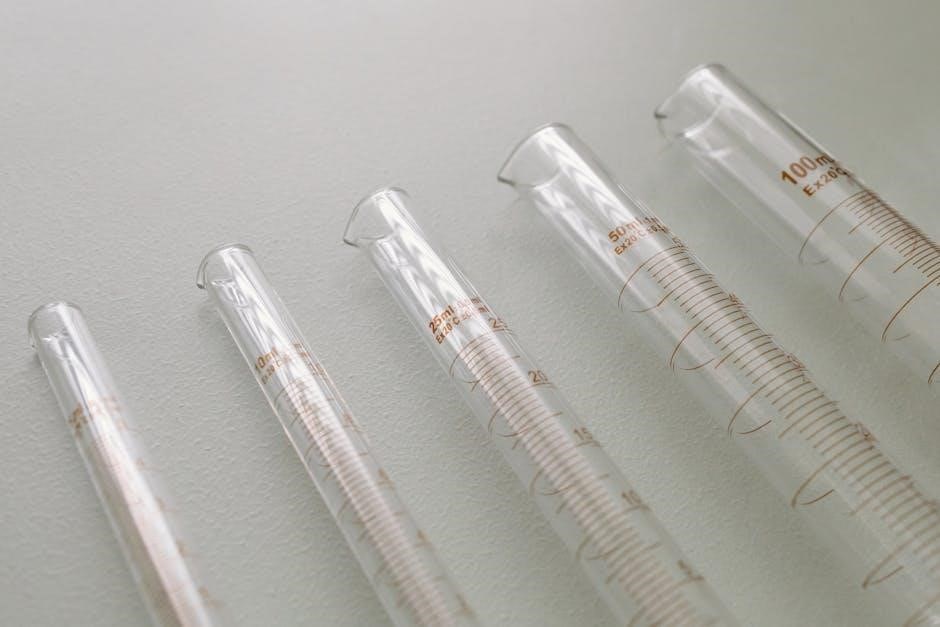
Worksheets focusing on decimal and fractional dimensions elevate the complexity of volume calculations for prisms and cylinders. Students must accurately apply the formulas (V = Bh for prisms‚ V = πr²h for cylinders) while handling non-integer values.
PDF resources often provide step-by-step examples demonstrating how to convert fractions to decimals or vice versa‚ ensuring consistent calculations. Answer keys are essential for verifying the accuracy of these more intricate computations. These exercises reinforce the importance of order of operations and precise arithmetic.
Many worksheets include problems requiring students to round their final answers to a specified decimal place‚ mirroring real-world applications. Mastering these skills builds confidence and prepares students for more advanced mathematical challenges. Utilizing the provided answer keys allows for immediate feedback and error correction.
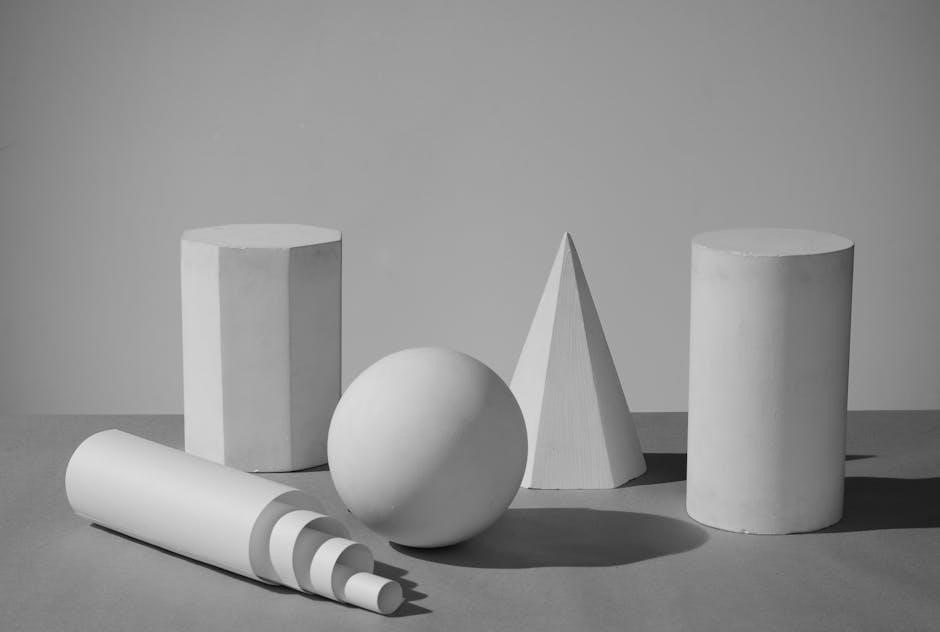
Worksheet Resources & Answer Keys
PDF worksheets are widely available online for practicing volume calculations. Convenient answer keys are often included‚ enabling self-assessment and reinforcing learning effectively!
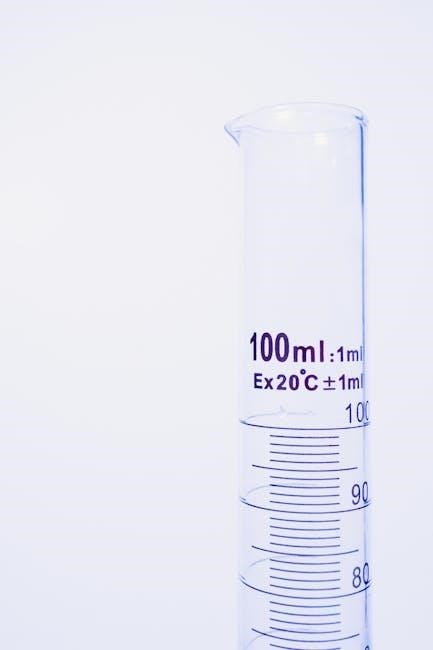
Finding Free Printable Worksheets (PDF Format)
Numerous websites offer free‚ printable volume worksheets in PDF format‚ specifically designed for prisms and cylinders. A quick online search using keywords like “volume of prisms and cylinders worksheet pdf” will yield a wealth of resources.
Mathworksheets4kids.com is a popular choice‚ providing a diverse range of worksheets catering to different skill levels. Other valuable resources include educational websites offering free math printables‚ and many teacher resource sites. These PDF documents typically include a variety of problems‚ ranging from basic calculations with rectangular prisms to more complex scenarios involving triangular prisms and cylinders with varying dimensions.
When selecting a worksheet‚ consider the student’s current understanding and the specific concepts you want to reinforce. Look for worksheets that clearly illustrate the shapes and provide sufficient space for students to show their work. Remember to also search for accompanying answer keys to facilitate easy grading and self-assessment. These resources are invaluable for both classroom instruction and independent practice.
Locating Answer Keys for Practice Problems
Finding answer keys for volume of prisms and cylinders worksheet practice is often straightforward. Many websites hosting the PDF worksheets also provide separate answer key files‚ usually available for download directly alongside the worksheet itself. Look for links labeled “Answer Key‚” “Solutions‚” or similar terms.
If the answer key isn’t directly available on the website‚ a targeted online search using the worksheet’s title or a unique problem identifier can often locate it. Teacher resource websites and educational forums frequently share answer keys as well. Some worksheets embed the solutions within a separate page of the PDF document itself – be sure to review the entire file.
Occasionally‚ answer keys are presented as PowerPoint presentations or in a separate document format. Utilizing these resources allows for efficient self-checking and provides valuable feedback for students learning to calculate volume. Always verify the solutions to ensure accuracy and understanding.
Common Errors and How to Avoid Them
When tackling volume of prisms and cylinders worksheet problems‚ several common errors frequently occur. A primary mistake involves using the incorrect formula – remember V = Bh for prisms and V = πr²h for cylinders. Students often confuse area and volume‚ or miscalculate the base area (B) of prisms.
Another frequent error is incorrect unit conversion. Ensure all dimensions are in the same units before calculating volume‚ and express the final answer in cubic units (e.g.‚ cm³‚ m³). Forgetting to square the radius (r) in the cylinder volume formula is also common. Carefully review the answer key to identify these mistakes.
When using a PDF worksheet‚ double-check that all given dimensions are accurately transcribed. Practicing with varied problems and consistently verifying solutions against the answer key will significantly reduce these errors and build confidence.
Leave a Reply